• 19 Posts
  • 4.15K Comments
Joined 3 years ago
cake
Cake day: June 14th, 2023

help-circle

  • Aliens: “We have the cure for cancer.”

    Humans: “Great! What is it?”

    Aliens: “Just stop your cells from reproducing. That creates translation errors which can result in run-away mitosis and mutation.”

    Humans: “Uh… okay, but if we’re not using cells, what should we use to form our bodies instead?”

    Aliens: “Sandstone is good. Marble is better.”

    Humans: “Okay, we’ll give it a shot.”

    3000 years of Egyptians and Greeks perfecting the sculpture later…

    Humans: “Nope. Still got cancer.”


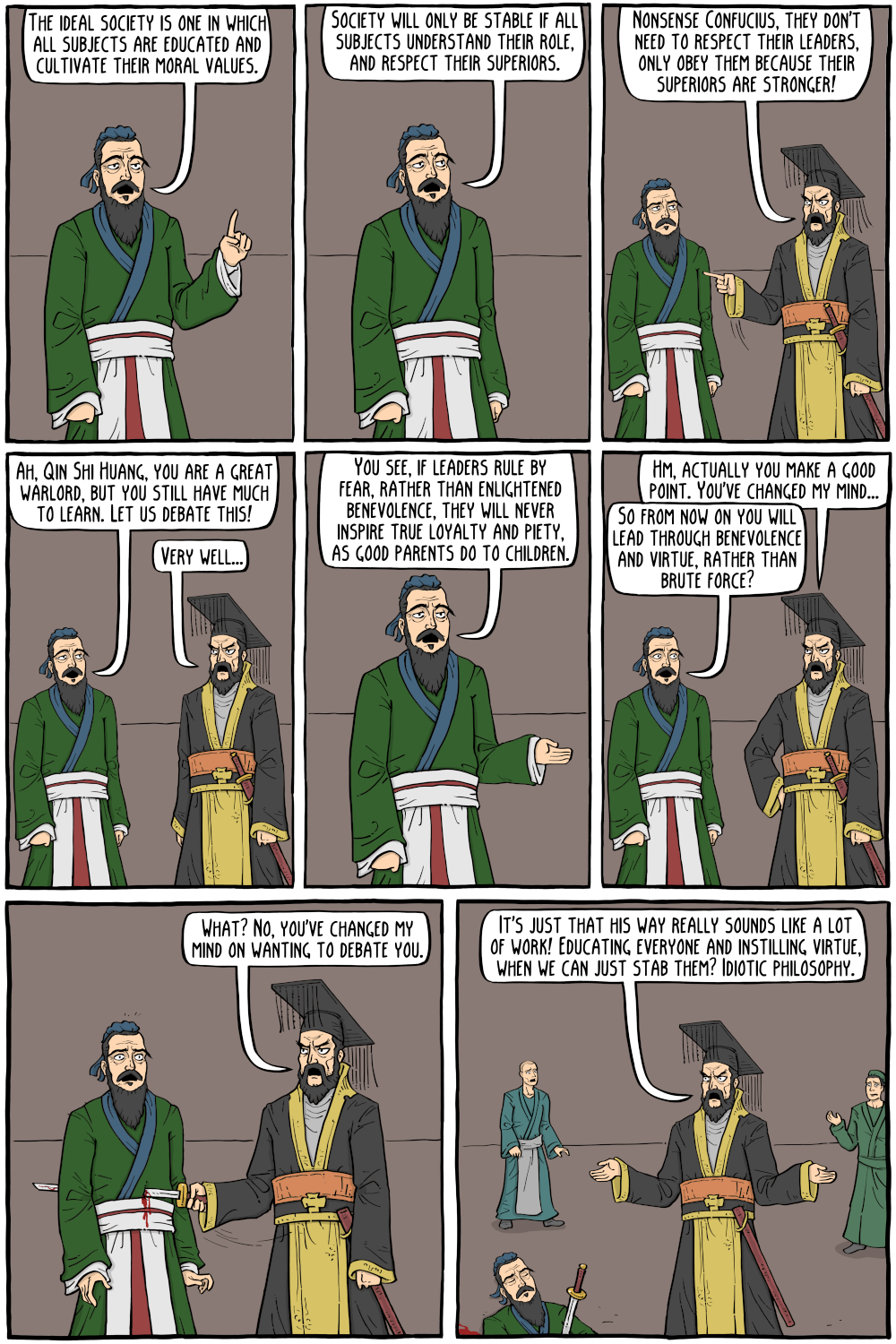
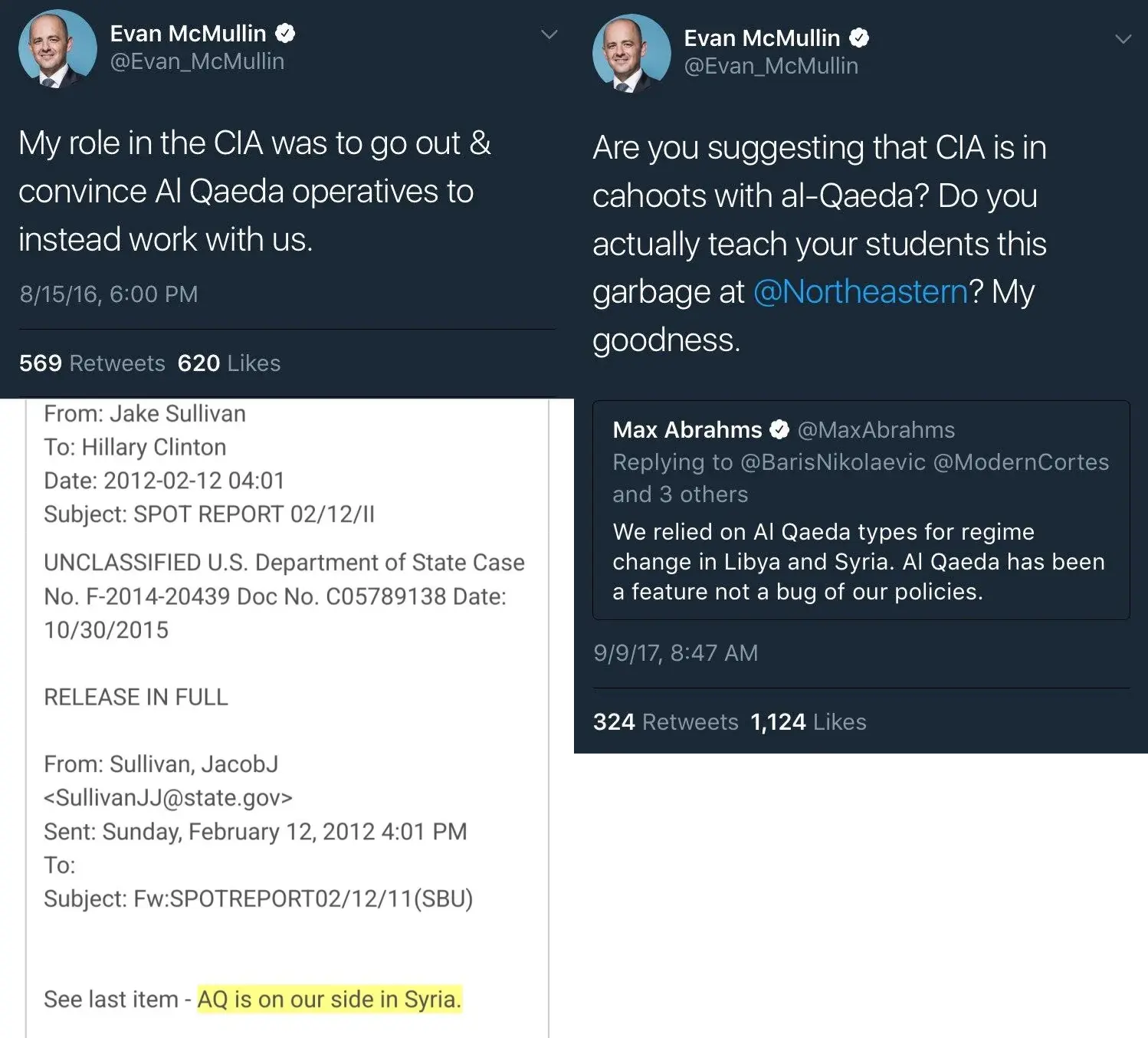
  • The second panel hit me hard, knowing how USAID operates in practice relative to how it is portrayed in media.

    After taking power in April 1978, the People’s Democratic Party of Afghanistan (PDPA) instituted an array of socialist policies, including “land reform, growth in public services, price controls, separation of church and state, full equality for women, legalization of trade unions and a sweeping literacy campaign.” This might seem like a positive development, but not in the eyes of the U.S. empire and its capitalist agenda. In addition to the CIA’s covert support for the mujahideen’s holy war against the secular evils of increased living standards and women’s rights, USAID also played an interesting role in this conflict.

    The agency reportedly spent $50 million on a “jihad literacy” program in Afghanistan, primarily during the 1980s. This effort included the publication and distribution of ultra-conservative textbooks that “tried to solidify the links between violence and religious obligation,” according to author Dana Burde. Lessons on basic math and language were accompanied by depictions of Kalashnikov rifles, grenades, ammunition, and a commitment to militancy and retribution against the Russians (who were depicted as “invaders” despite having been invited to lend military assistance by the PDPA). After consolidating power in the ‘90s, the Taliban government revised and reprinted these textbooks, and copies have even been found in Pakistan as recently as 2013.

    Assisting the Taliban’s precursor with reactionary, jihadist propaganda to viciously sabotage a progressive, feminist government and its allies is a strange form of “humanitarianism.” You might even say it’s the opposite of humanitarianism. Was this just a mistake that USAID made in the distant past and has since learned from, or is there a continued pattern of this behavior?

    Fortunately, Afghanistan was half a world away. We liberated a foreign country from Soviet aggression. We struck a blow against Radical Leftist Socialism. And, as a consequence, we restored liberty and democracy to Eastern Europe. There wasn’t any risk of a radicalized movement of ultra-conservative religious fundamentalists ever doing anything that might blow back on American civilians.


  • Anyone who has read a Free Press article or Ross Douthat column or subscribed to The Economist knows this isn’t true.

    Conservative Intellectuals are a dime a dozen. The Ivy League is full of them. The courts are packed with them. Legions of Ben Shapiro wanna-bes goose step across Twitter and Facebook daily.

    Reading skills won’t make you progressive if all you’re reading is Rand and Heinlein. Intellectuals wrote The Bell Curve and justified the invasion of Iraq. Education is not ideologically neutral and being “smart” does to turn your vote Blue.

    The Causation on this is backwards. Progressives venerate academia. Academics don’t venerate progressivism.


  • I probably read 500 pages a week on average.

    Pride and Prejudice alone is 400 pages. Crime and Punishment is another 600 pages. If you have two Lit classes in the same semester, you’re going to have to double that rate or fall behind schedule. Nevermind retention.

    I remember sitting in a library surrounded by books, struggling to solve the 15 problems a class Engineering Physics assigned. Just a fist full of brain-teasers day in and day out. Three of us working together managed to clear the load in a couple of hours. Then on to the next assignment, which was another two or three hours. Five classes a day, you’re lucky when you have enough time to sleep.

    I’ll admit, I did a few summers at a community college and that workload was much smaller, the tests were far easier, and the graders significantly more forgiving. Crazy how little work it takes to ace an exam in High School Plus relative to a University weed-out program.


  • College kids have never read everything they’re assigned, of course, but this feels different.

    I love Vibes Based Reporting.

    Twenty years ago, Dames’s classes had no problem engaging in sophisticated discussions of Pride and Prejudice one week and Crime and Punishment the next. Now his students tell him up front that the reading load feels impossible. It’s not just the frenetic pace; they struggle to attend to small details while keeping track of the overall plot.

    As someone who was in college twenty years ago, I’ve got to say there’s no way in hell I could make it through an entire novel in a week while balancing the rest of my course load. Either I’m reading the Cliff’s Notes or I’m not getting it done. I also ran a 15-hour course study in hopes of landing a triple major in four years (bad idea, kids!), but even with a more conservative 12-hour load, imagine this plus 3 other classes making the same demands on your time.

    This isn’t a new problem. It is, perhaps, a problem that the current generation of students no longer has the cheat-codes to navigate. But doggedly insisting people were housing a 400-page book in a week and retaining it for meaningful discussion? Get fucked, dude. Nobody was actually doing that ever.

    If you could come to the table talking about these novels, its because you already read them in High School, not because you consumed them in a week in your hectic freshman year.


  • Feel like I need brain training.

    That’s just called “practice”. And I’ll say its easier to find when its already part of your day to day job activities. If you’re reading and writing with other collegiate professionals at a collegiate level, you’ll maintain your skills. Otherwise, you tend to sink to the common denominator.

    I don’t even think that’s bad per say, either. I wouldn’t expect a college athlete to maintain the skills of a 25 year old who trains 4 hours a day if they took up a desk job for ten years. The fixation on having Genius Level Skills at everything overlooks the cost-benefit of maintaining those skills when you have nothing to apply them to.

    The idea that the US population would somehow be better off if everyone read at a 12th grade level really begs the question “What are you doing with 12th grade reading/writing skills that would improve your life?” And none of these articles seem to have an answer to that question. It’s just intrinsically better because 12 > 6.

    Would your life be better if you could bench press 400 lbs rather than 200 lbs? Would it be better if you could do trigonometry in your head? Recite the Hamlet soliloquy by heart in the original Ye Olde English? I guess, maybe on the margins. But Idk how much of my life I can spare to achieve any one of these. And I don’t know if what I’d give up to achieve them would be better on balance.


  • I think a lot of people tend to get dumber after school’s over. Atrophy of the brain.

    You move from an environment that’s constantly challenging and stressing your brain muscles to an environment that asks you to do the same repetitive tasks as quickly as possible. I think the most glaring example of this is the recent tendency towards “Vibes Coding”.

    How AI Vibe Coding Is Erasing Developers’ Skills

    One developer on Hacker News mentioned this perfectly: “For a while, I barely bothered to check what Claude was doing because the code it generated tended to work on the first try. But now I realize I’ve stopped understanding my own codebase.”

    This is the trap. The AI works so well initially that you stop paying attention. You stop learning. You stop thinking. And by the time you realize what’s happened, your skills have already degraded significantly.

    And since most of the US syndicated news publications and entertainment fiction deliberately publish at a 6th grade level… that’s the level people tend to operate at for the rest of their adult lives.

    Adult literacy rate of my country is 99.8% which beats most of the world.

    I mean, 6th grade reading is literate. It’s not as though 6th graders can’t read. They just don’t have the advanced language skills you’d need to survive a college course on Proust or whatever.


  • Goes a bit farther than that. I have a family friend who struggles to read the menus at restaurants. But she’s also desperately poor, a high school drop out, and regularly between jobs in a service sector that’s totally unforgiving to people in her position.

    I do think there’s a reinforcing cycle of “Everything is written at the 6th grade level” -> “Everyone communicates at the 6th grade level”. But I also don’t think these articles do a good job of defining the difference between a 4th grade, 8th grade, 12th grade, collegiate level. So when you see this statistic, its not entirely clear what the problem is, per say. Like, what isn’t being communicated beyond 6th grade literacy levels that people need?

    Per the article:

    Here’s the ugly truth nobody wants to admit: a barely literate population is a controllable population.

    Can’t read complex policy documents? Perfect. You’ll vote based on slogans and fear. Can’t analyze contradictory news sources? Excellent. You’ll believe whatever authority figure shouts loudest. Can’t understand financial fine print? Outstanding. You’ll sign predatory loans and carry crippling debt forever.

    Mental health outcomes are catastrophic. Depression rates have skyrocketed. Anxiety disorders are endemic. Suicide rates have surged, particularly among young people who inherit this deteriorating nightmare and see no viable future.

    The economic cost of illiteracy alone is staggering — research shows that raising every American adult to sixth-grade reading level would generate an additional $2.2 trillion annually.

    Few citations, lots of big claims and speculative statements, the tendency to catastrophize (and inject implicit nostalgia) as though 6th grade literacy trends are a shocking new development rather than the historical baseline.

    None of it really translates into actionable policy. All it seems to do is feed the prevailing Everyone is Stupid Except Me self-aggrandizing outlook. I tend to see these articles paired with the inevitable reactionary “We should impose literacy tests on voting” and “Would have this problem if not for all the damned rednecks / illegals / minorities / <insert reviled social group here>” outlooks.